Google Stitch: The End of Traditional Web Design and What It Means for Agencies
Google I/O 2026 introduced Chapter 7 on Generative Media, making it clear that the technical barriers to web design are collapsing. Google showcased new tools that generate entire user interfaces and graphic assets in seconds. For web agencies, selling pixel-perfect mockups and manual code translation is no longer a viable business model.
Google Stitch: UI at the Speed of Thought
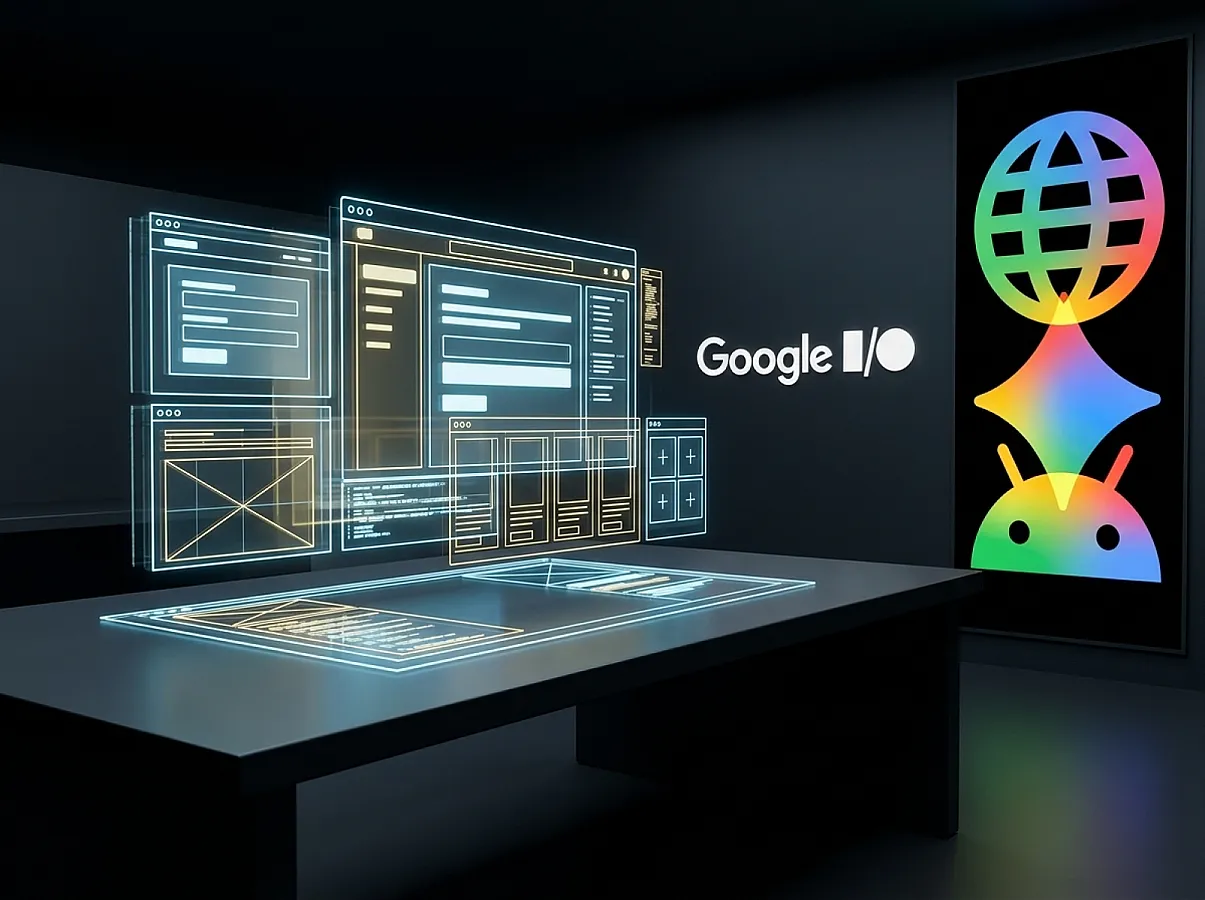
Google introduced Stitch, an AI design product that turns rough concepts into complete UI layouts. During the presentation, a pizza shop owner with no design experience used a single prompt to generate a website layout live. Users can collaborate with Stitch using voice commands like "make the header text larger" and watch the layout update in real time. Stitch can then export the design directly to code or launch the website with a few clicks. Internally, Google has already used Stitch to generate over 100 million UI screens in the last year.
The Cafali Perspective: The traditional agency model of charging clients thousands of dollars for weeks of wireframes and revisions is dead. Clients will not pay for manual UI iteration when an AI can build and refine a layout instantly.
Agencies must stop selling "pixels" and start selling business strategy. The layout itself is now a commodity. The real value is in conversion rate optimization, user psychology, and ensuring the interface drives actual revenue. Agencies that try to compete with AI on sheer design speed will lose. They must pivot to becoming growth partners.
Google Pics: Autonomous Asset Creation
Google also announced Pics, a new Workspace tool that handles image creation and editing with precise creative control. It understands the objects within a canvas. A user can hover over an element to remove it, resize objects to fit a frame, and automatically generate infographics or marketing materials.
The Cafali Perspective: Asset creation has always been a major bottleneck in web design and digital marketing. Waiting for a graphic designer to slice images or create banners delays campaign launches.
With tools like Google Pics, agencies can produce massive volumes of high-quality campaign assets without relying on large design teams. This drastically lowers overhead and speeds up the delivery of landing pages and ad creatives. The bottleneck shifts from asset production to asset strategy. The agency's role is to determine which message resonates with the target audience.
The Death of Manual Integration
Stitch does not just create pictures of websites. It exports designs directly to functional code. The gap between a visual idea and a live, clickable product has shrunk to near zero.
The Cafali Perspective: For decades, agencies justified high retainers based on the technical difficulty of converting a design into HTML, CSS, and JavaScript. That technical moat no longer exists.
The focus of a technical agency must shift to the backend and the infrastructure. While an AI can generate the frontend of a pizza shop, connecting that frontend to complex inventory systems, AI agents via WebMCP, and third-party logistics still requires expert architecture. Agencies must become systems integrators. The front end is solved. The back end and the AI orchestration layer are where the lucrative work remains.