Meta Ads AI Connectors Need an Operator
Meta's ads AI connectors are not just another AI feature.
The important part is the architecture behind them. Meta says its ads AI connectors are enabled by an ads Model Context Protocol server and an ads command line interface. In plain English: Meta is creating a more official way for conversational AI agents to connect to a Meta ad account with account context.
That is the real story.
For agencies, this matters because paid media work has always had a timing problem. The ad account may show what changed. The CRM may show whether the leads were any good. The landing page may show where users dropped off. The creative history may show which angle is getting tired. The client may have sales feedback that changes the interpretation.
But those signals usually live in different places.
By the time someone opens Ads Manager, checks yesterday's spend, compares performance, asks the team for lead quality, and writes up the recommendation, the campaign may have already wasted money.
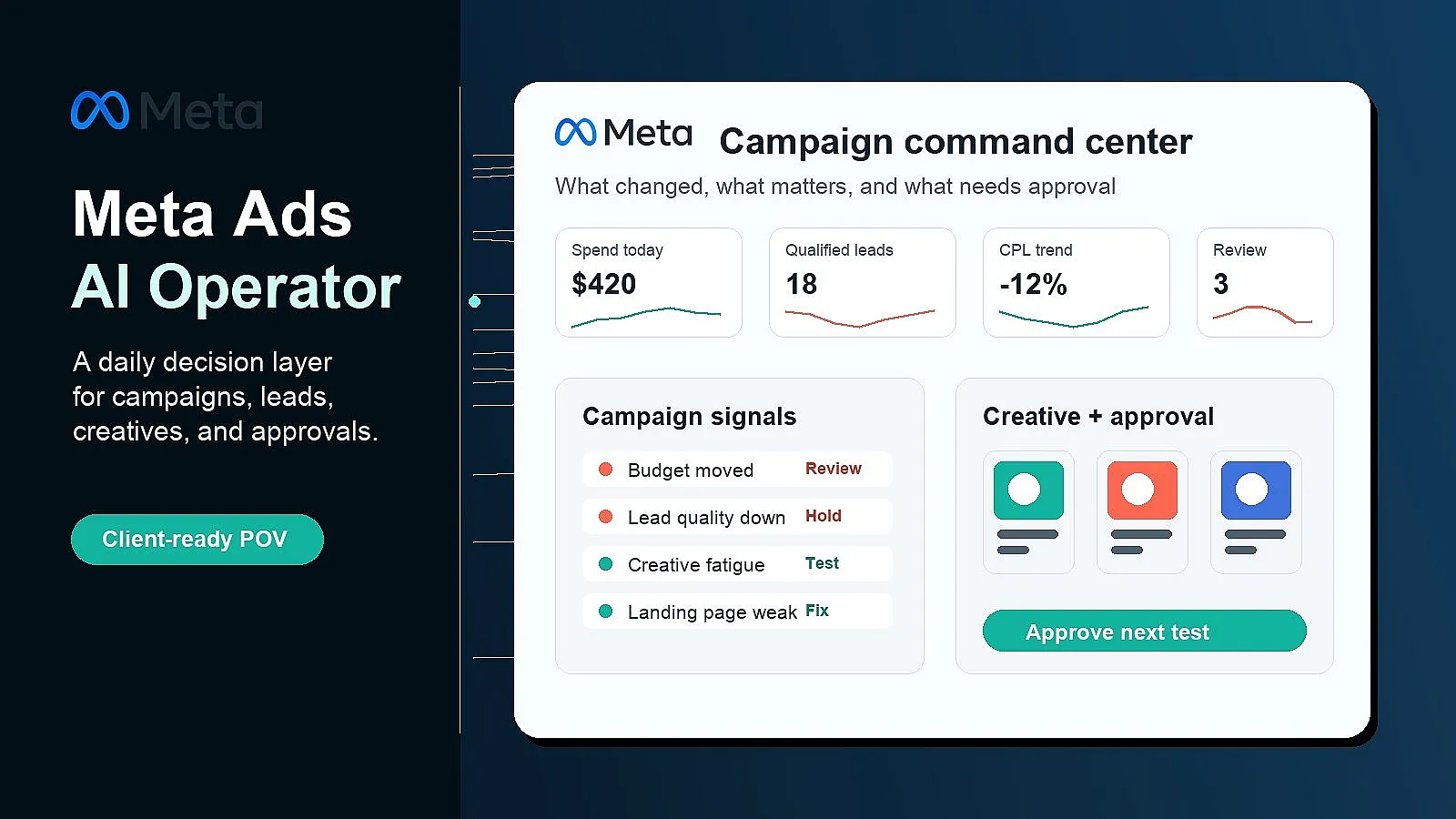
Meta's MCP move points toward a different workflow: an AI operator sitting closer to the account, watching for changes, connecting context, and preparing the next decision while there is still time to act.
Why MCP changes the ad workflow
MCP gives AI agents a standard way to connect with tools and context. That sounds technical, but the business implication is simple: AI stops being limited to chat about a report and starts getting closer to the workflow itself.
For Meta Ads, that could mean an agent can help with the operational loop around campaigns:
- Inspect campaign and ad set changes
- Compare performance against recent history
- Spot creative fatigue signals
- Surface spend shifts that need review
- Connect campaign data to lead quality from the CRM
- Draft a recommendation for the media buyer
- Ask for approval before any risky change
That last point matters.
The goal should not be blind autopilot. Nobody serious should want an agent moving budget without business context. The useful version is an operator: it watches, investigates, explains, recommends, and routes approvals.
The agency still owns strategy. The agent tightens the loop.
The current loop is too slow

Most paid media teams still run a manual loop:
- Launch the campaign.
- Wait for data.
- Check Ads Manager.
- Compare performance against yesterday or last week.
- Ask why the numbers moved.
- Check whether leads are actually qualified.
- Decide what to change.
- Ask for approval.
- Apply the change.
Good media buyers do this well. They know when a lead source looks suspicious, when a creative has peaked, and when Meta is optimizing toward the wrong behavior.
The problem is not skill. The problem is latency.
A campaign can start spending too much before the team catches it. A creative can keep getting clicks after the quality drops. A form can drive more conversions and still send bad leads into the pipeline. A landing page can receive traffic all day before anyone notices the conversion issue.
An AI operator becomes useful when it reduces the time between signal and action.
Platform metrics are not enough

Meta can tell you which campaign produced the cheapest lead.
It often cannot tell you whether that lead was worth calling.
That difference matters. A campaign can lower CPL by attracting the wrong buyer. A creative can raise CTR by making a promise the sales team cannot defend. A form can increase conversions and still send junk into the pipeline.
This is where the operator idea becomes more important than the connector itself.
The Meta connector can expose the ad account side of the work. But a strong operating layer also needs business context:
- CRM lead quality
- Sales capacity
- Margin
- Offer positioning
- Landing page behavior
- Creative history
- Client constraints
- Offline sales feedback
Without that context, AI can optimize the wrong thing faster.
With that context, it can help the team catch problems earlier and make cleaner decisions.
A practical first version
The first useful version does not need full campaign autopilot.
It needs a strong daily operating rhythm.
Each morning, the agent could review the Meta ad account and answer:
- What changed since yesterday?
- Where did spend move?
- Which campaigns deserve attention?
- Which creatives are showing fatigue?
- Which ad sets are producing leads that look low quality?
- Which landing pages need a test?
- Which recommendations need human approval?
Then the team receives a decision brief instead of a pile of screenshots.
For example:
Campaign A increased spend 28 percent while qualified leads dropped. Creative 3 is still getting clicks, but CRM quality fell after Thursday. Hold budget steady for now. Test a new buyer-intent angle and review lead form questions before increasing spend.
That is useful because it connects platform activity to a business decision.
What agencies can build around this
The biggest opportunity is not a prettier dashboard.
It is the operating layer around the ad account.
That layer should:
- Watch the account.
- Understand what changed.
- Compare performance against business goals.
- Pull in CRM and website context.
- Recommend the next action.
- Ask for approval when spend or brand risk is involved.
- Learn from the result.
Meta's ads MCP server can make the platform connection more official. Agencies can build the layer that turns that connection into better operations.
This is where the value is. Not in asking AI to explain a chart. In helping a team decide what deserves attention today.
What this means for small businesses

Small businesses do not want another tool to check.
They want a clear daily answer:
- We spent $420 yesterday.
- Two ads produced most of the leads.
- One campaign is getting cheaper leads, but quality looks worse.
- The best next test is a new landing page headline.
- No urgent budget change is recommended today.
That is more useful than a generic report because it connects performance to a decision.
The owner still decides. The system reduces the time between signal and action.
Cafali's take
At Cafali, we see Meta's ads AI connectors as one of the more practical AI developments for businesses that spend money on ads.
The reason is not hype around AI.
The reason is operational leverage.
Meta Ads already produces the signals. Agencies already know how to make the decisions. MCP-based access can help AI agents get closer to the account context. The missing piece is a system that connects platform signals, business context, and approvals fast enough to matter.
That is why Meta Ads does not just need an AI assistant.
It needs an operator.